Global Crossroads: Oil's Dip, Economic Jitters, and Iran's Shadow Propel Bitcoin as a New Horizon Amidst Geopolitical Unrest
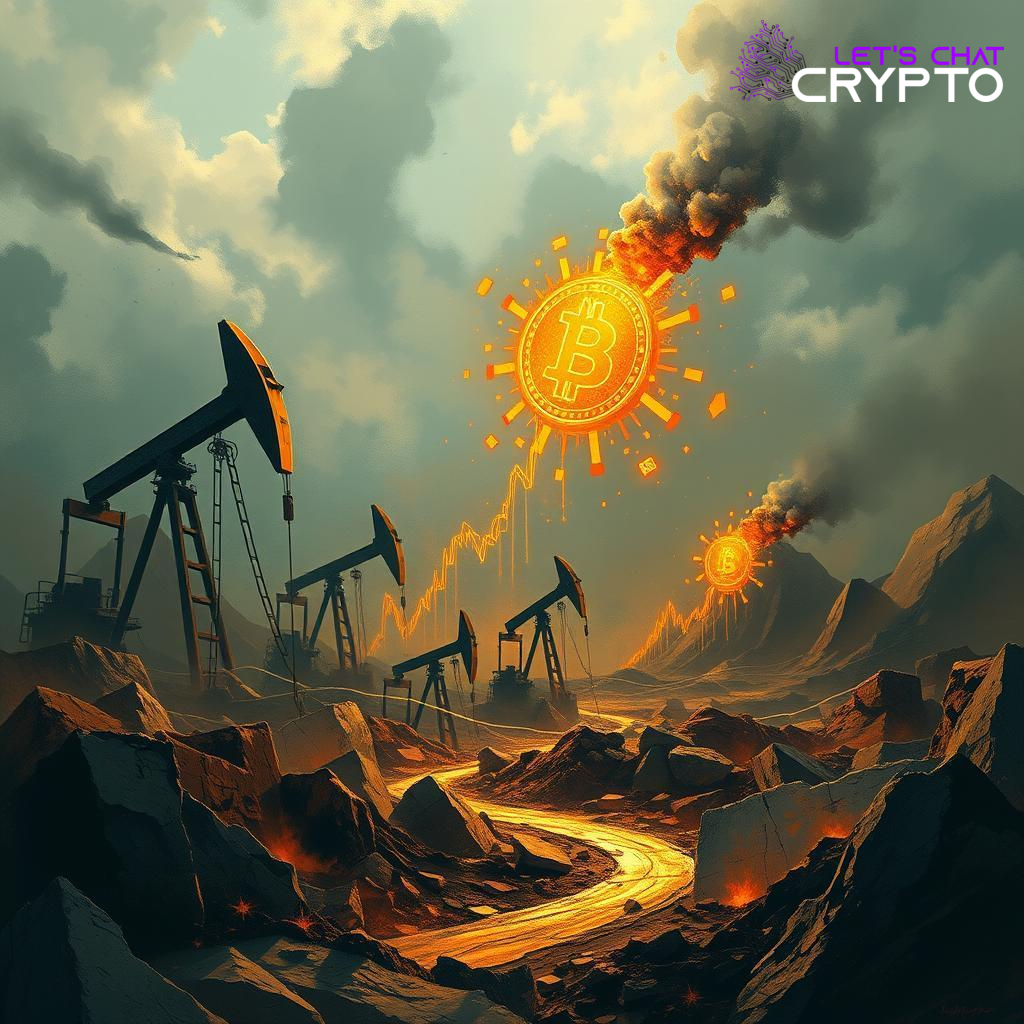
The global economic landscape is undergoing a nuanced transformation, marked by a convergence of geopolitical tensions, fluctuating commodity markets, and shifting investor sentiment towards digital assets. While the initial focus of the ongoing Iran conflict understandably centered on crude oil, with market observers closely monitoring its price trajectory, a more intricate and pervasive disruption has begun to unravel within the hidden plumbing of global trade. Surprisingly, as oil prices have recently receded below the $90 per barrel mark, Bitcoin has demonstrated a notable ascent, signaling a potential recalibration of risk perception and value preservation.
The Evolving Narrative of Oil and Global Trade
The recent dip in crude oil prices, moving below a critical psychological threshold, reflects a complex interplay of factors. While initial fears of immediate supply disruptions from the Middle East may have somewhat abated, underlying concerns regarding global demand appear to be gaining prominence. Economic indicators from key regions are painting a picture of moderated growth, influencing projections for energy consumption. This shift suggests that the market is now processing a broader spectrum of economic anxieties, tempering the immediate geopolitical premium on oil.
Economic Headwinds: China's Trade and US Inflation
Concurrently, critical economic data points underscore persistent headwinds. China, a principal engine of global growth, has reported weaker-than-anticipated trade figures. Both exports and imports have shown signs of contraction or significant slowdown, reflecting not only softened international demand but also internal economic pressures. This deceleration in the world's second-largest economy carries substantial implications for global supply chains and overall economic momentum.
Across the Pacific, the United States continues to navigate its inflation trajectory. While recent data suggests a modest cooling from peak levels, core inflation remains stubbornly elevated, presenting a persistent challenge for monetary policymakers. The Federal Reserve's cautious stance, balancing the imperatives of price stability with sustainable growth, keeps market participants on edge regarding future interest rate decisions. A weakening of these economic pillars in major economies contributes to an environment of heightened uncertainty.
Iran's Expanding Contagion Beyond Crude
The repercussions of the Iran conflict extend far beyond the immediate impact on oil supply. The geopolitical instability in the Middle East is increasingly disrupting the logistical arteries of global commerce. Key maritime routes, particularly those passing through critical chokepoints like the Strait of Hormuz, face heightened risks, leading to increased shipping insurance premiums and longer transit times as vessels reroute. This 'contagion' seeps into various sectors, elevating operational costs for businesses worldwide and adding another layer of complexity to already fragile global supply chains. The invisible costs of geopolitical tension are manifesting in tangible economic consequences.
Bitcoin's Ascent: A Digital Sanctuary?
Amidst this backdrop of falling oil prices, economic uncertainty, and spreading geopolitical friction, Bitcoin has embarked on a significant rally. The cryptocurrency's performance has increasingly drawn attention as investors seek alternatives to traditional asset classes. Its perceived characteristics as a decentralized, borderless asset, potentially uncorrelated with conventional markets, position it uniquely. In an environment where fiat currencies are subject to inflationary pressures and geopolitical machinations, Bitcoin's narrative as 'digital gold' or a hedge against instability appears to be gaining traction. Its recent price action suggests that a segment of the market views it as a viable safe haven, or at least a compelling speculative asset, capable of navigating the turbulences of traditional finance and geopolitics.
Summary
The current global economic and geopolitical landscape presents a intricate web of interconnected challenges. The decline in oil prices, rather than solely signaling eased tensions, also reflects broader concerns about global demand. This is amplified by weakening trade data from China and persistent inflation challenges in the U.S. Crucially, the Iran conflict's 'contagion' is now visibly impacting global trade infrastructure beyond just crude, increasing costs and uncertainty. In this volatile environment, Bitcoin's recent surge underscores a discernible shift in investor strategy, as market participants explore alternative assets capable of hedging against traditional market instability and geopolitical risk. The digital asset appears to be carving out a unique niche as a potential sanctuary in an increasingly complex world.
Resources
- Bloomberg: For comprehensive coverage of global market trends, commodity prices, and economic indicators.
- Reuters: Provides in-depth reporting on geopolitical events, international trade, and shipping dynamics.
- CoinDesk: A leading source for news, analysis, and data on Bitcoin and the broader cryptocurrency market.
Details
Author
Top articles


 }})
You can now watch HBO Max for $10
Latest articles



You can now watch HBO Max for $10
The global economic landscape is undergoing a nuanced transformation, marked by a convergence of geopolitical tensions, fluctuating commodity markets, and shifting investor sentiment towards digital assets. While the initial focus of the ongoing Iran conflict understandably centered on crude oil, with market observers closely monitoring its price trajectory, a more intricate and pervasive disruption has begun to unravel within the hidden plumbing of global trade. Surprisingly, as oil prices have recently receded below the $90 per barrel mark, Bitcoin has demonstrated a notable ascent, signaling a potential recalibration of risk perception and value preservation.
The Evolving Narrative of Oil and Global Trade
The recent dip in crude oil prices, moving below a critical psychological threshold, reflects a complex interplay of factors. While initial fears of immediate supply disruptions from the Middle East may have somewhat abated, underlying concerns regarding global demand appear to be gaining prominence. Economic indicators from key regions are painting a picture of moderated growth, influencing projections for energy consumption. This shift suggests that the market is now processing a broader spectrum of economic anxieties, tempering the immediate geopolitical premium on oil.
Economic Headwinds: China's Trade and US Inflation
Concurrently, critical economic data points underscore persistent headwinds. China, a principal engine of global growth, has reported weaker-than-anticipated trade figures. Both exports and imports have shown signs of contraction or significant slowdown, reflecting not only softened international demand but also internal economic pressures. This deceleration in the world's second-largest economy carries substantial implications for global supply chains and overall economic momentum.
Across the Pacific, the United States continues to navigate its inflation trajectory. While recent data suggests a modest cooling from peak levels, core inflation remains stubbornly elevated, presenting a persistent challenge for monetary policymakers. The Federal Reserve's cautious stance, balancing the imperatives of price stability with sustainable growth, keeps market participants on edge regarding future interest rate decisions. A weakening of these economic pillars in major economies contributes to an environment of heightened uncertainty.
Iran's Expanding Contagion Beyond Crude
The repercussions of the Iran conflict extend far beyond the immediate impact on oil supply. The geopolitical instability in the Middle East is increasingly disrupting the logistical arteries of global commerce. Key maritime routes, particularly those passing through critical chokepoints like the Strait of Hormuz, face heightened risks, leading to increased shipping insurance premiums and longer transit times as vessels reroute. This 'contagion' seeps into various sectors, elevating operational costs for businesses worldwide and adding another layer of complexity to already fragile global supply chains. The invisible costs of geopolitical tension are manifesting in tangible economic consequences.
Bitcoin's Ascent: A Digital Sanctuary?
Amidst this backdrop of falling oil prices, economic uncertainty, and spreading geopolitical friction, Bitcoin has embarked on a significant rally. The cryptocurrency's performance has increasingly drawn attention as investors seek alternatives to traditional asset classes. Its perceived characteristics as a decentralized, borderless asset, potentially uncorrelated with conventional markets, position it uniquely. In an environment where fiat currencies are subject to inflationary pressures and geopolitical machinations, Bitcoin's narrative as 'digital gold' or a hedge against instability appears to be gaining traction. Its recent price action suggests that a segment of the market views it as a viable safe haven, or at least a compelling speculative asset, capable of navigating the turbulences of traditional finance and geopolitics.
Summary
The current global economic and geopolitical landscape presents a intricate web of interconnected challenges. The decline in oil prices, rather than solely signaling eased tensions, also reflects broader concerns about global demand. This is amplified by weakening trade data from China and persistent inflation challenges in the U.S. Crucially, the Iran conflict's 'contagion' is now visibly impacting global trade infrastructure beyond just crude, increasing costs and uncertainty. In this volatile environment, Bitcoin's recent surge underscores a discernible shift in investor strategy, as market participants explore alternative assets capable of hedging against traditional market instability and geopolitical risk. The digital asset appears to be carving out a unique niche as a potential sanctuary in an increasingly complex world.
Resources
- Bloomberg: For comprehensive coverage of global market trends, commodity prices, and economic indicators.
- Reuters: Provides in-depth reporting on geopolitical events, international trade, and shipping dynamics.
- CoinDesk: A leading source for news, analysis, and data on Bitcoin and the broader cryptocurrency market.
Top articles
You can now watch HBO Max for $10
Latest articles
You can now watch HBO Max for $10
Similar posts

This is a page that only logged-in people can visit. Don't you feel special? Try clicking on a button below to do some things you can't do when you're logged out.
Example modal
At your leisure, please peruse this excerpt from a whale of a tale.
Chapter 1: Loomings.
Call me Ishmael. Some years ago—never mind how long precisely—having little or no money in my purse, and nothing particular to interest me on shore, I thought I would sail about a little and see the watery part of the world. It is a way I have of driving off the spleen and regulating the circulation. Whenever I find myself growing grim about the mouth; whenever it is a damp, drizzly November in my soul; whenever I find myself involuntarily pausing before coffin warehouses, and bringing up the rear of every funeral I meet; and especially whenever my hypos get such an upper hand of me, that it requires a strong moral principle to prevent me from deliberately stepping into the street, and methodically knocking people's hats off—then, I account it high time to get to sea as soon as I can. This is my substitute for pistol and ball. With a philosophical flourish Cato throws himself upon his sword; I quietly take to the ship. There is nothing surprising in this. If they but knew it, almost all men in their degree, some time or other, cherish very nearly the same feelings towards the ocean with me.
Comment